

When people hear the word “creativity,” they often think of artists, musicians, writers, or people who consider themselves naturally creative.
But creativity is not reserved for a select few. It is a natural human capacity, and research continues to show that engaging in creative activities can support mental and emotional well-being in meaningful ways.
Creativity gives us a way to process experiences, express emotions, reduce stress, and connect more deeply with ourselves and others.
Whether through drawing, painting, journaling, movement, music, collage, or other forms of creative expression, the act of creating can help us shift out of constant thinking and into a more present, embodied state.
Creativity Helps Reduce Stress
Many of us spend our days moving from task to task, responding to emails, managing responsibilities, and solving problems. While these activities are necessary, they often keep us in a state of constant mental activity.
Creative practices offer a different experience.
When we become absorbed in the process of creating, our attention naturally shifts away from worries about the future or rumination about the past. We become focused on what is happening in the present moment.
This is one reason many people leave creative wellness sessions saying things like:
“I haven’t thought about work for an hour.”
“Wow it’s already been 30 minutes.”
“I forgot to check my phone.”
“I feel calmer than I have all week.”
The goal is not to create a masterpiece.
The goal is to create an opportunity for the nervous system to settle, for your mind to focus and your body to relax.
Creativity Supports Emotional Expression
Not every experience can be easily put into words.
Sometimes emotions show up as tension in the body, racing thoughts, irritability, exhaustion, or a feeling that something is stuck.
Creative expression provides another language.
Through color, movement, imagery, writing, or sound, we can explore thoughts and feelings that may be difficult to articulate. The process itself often creates insight, clarity, and a greater sense of self-awareness.
Creativity Encourages Connection
One of the most powerful aspects of creative wellness is that it can be both personal and communal.
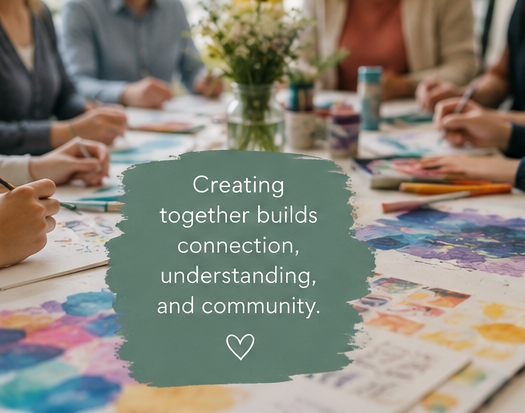
Creating alongside others reminds us that we are not alone.
Whether in a workplace, healthcare setting, community group, or retreat environment, shared creative experiences often foster connection, empathy, and belonging.
People begin to see one another differently. Conversations deepen. New perspectives emerge.
Creativity creates space for authentic human connection.
You Don’t Have to Be Creative
One of the most common things I hear before a workshop is:
“I’m not creative.”
The good news is that creative wellness is not about artistic skill or talent.
You do not need experience, training, or natural ability to benefit from the process.
Creative wellness is about curiosity, exploration, and self-expression. It is about giving yourself permission to play, experiment, and engage with the creative process without judgment.
A Gentle Path Toward Well-Being
Creativity is not a cure-all, but it can be a powerful support for mental and emotional well-being.
It invites us to slow down, pay attention, express ourselves, and reconnect with what matters most.
In a world that often asks us to do more, move faster, and stay productive, creative practices offer something different:
A chance to pause, breathe, create, and simply be human.
Want to experience creative wellness for yourself?
Explore upcoming workshops, private sessions, or corporate wellness offerings here on my website.